
Let’s be honest: there is nothing quite like the magic of a clownfish weaving through a reef display. Because they are incredibly hardy, active, and full of personality, clownfish are the ultimate gateway into the saltwater hobby. But you don’t need a massive, 100-gallon glass monster taking over your living room to build a thriving piece of the ocean.
In fact, the “nano reef” is arguably the sweet spot for keeping a bonded pair of clownfish.
After years of managing setups ranging from small desktop systems to massive, 1,000-gallon fish rooms, I’ve found the ultimate blueprint for a simple, low-maintenance dedicated clownfish aquarium. Today, I’m taking you behind the scenes of my personal favorite setup: a 25-gallon lagoon-style nano tank.
Here is exactly how to set it up, the gear I personally use to keep it pristine, and the secrets to long-term success.
The Nano Care Sheet: Quick-Glance Target Parameters
Before we talk gear, let’s look at the baseline environment your clownfish need to thrive. Nano fish tanks are beautiful, but because of their lower water volume, parameter stability is everything.
| Metric | Target Value | Why It Matters |
|---|---|---|
| Tank Size | 10 to 25 gallons (for nano tank) | Perfect space for a pair without territory issues. |
| Temperature | 76°F – 78°F | Keeps their metabolism steady and active. |
| Specific Gravity | 1.024 – 1.026 | Standard marine reef salinity. |
| pH Range | 8.1 – 8.4 | Essential for calcification and metabolic health. |
| The 0-20 Rule | Ammonia & Nitrites: 0 ppm Nitrates: <20 ppm | Keeps the water safe from fatal chemical spikes. |
The Foundation: The Innovative Marine 25-Gallon Lagoon
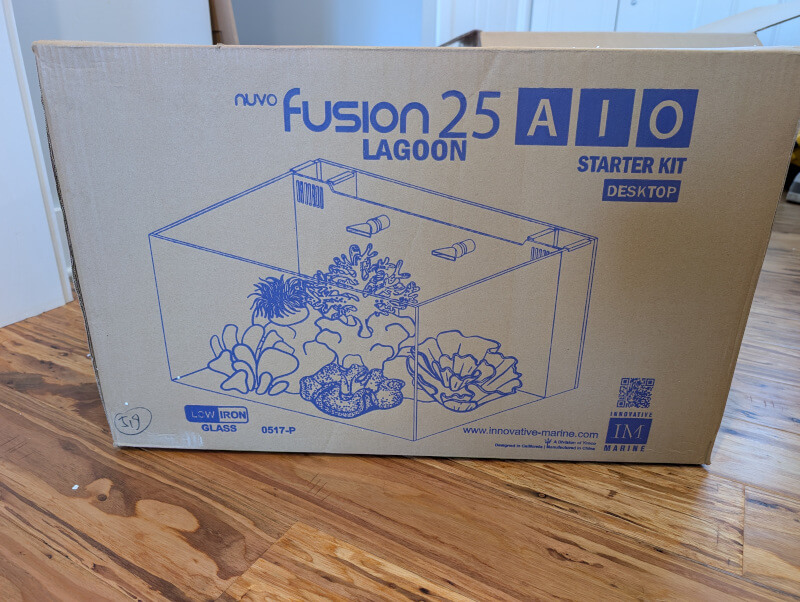
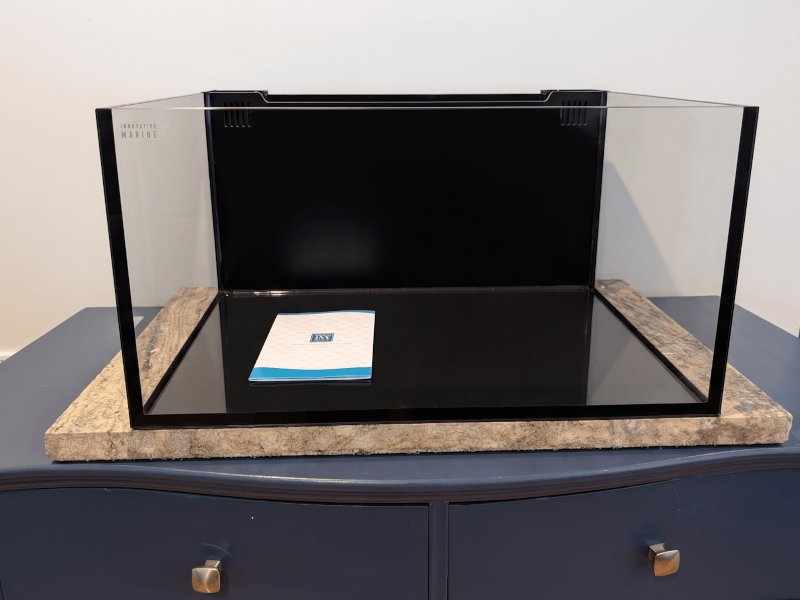
When choosing a tank model, I specifically went with the Innovative Marine 25-Gallon Fusion Lagoon.
Why a lagoon? Traditional nano tanks tend to be tall and narrow. A lagoon-style tank flips the script by giving you a wide, shallow footprint (24” x 20” x 12”).
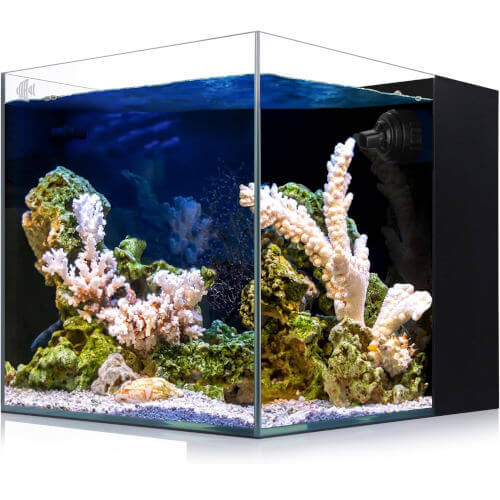
I also found this tank specifically to be an incredible value for the price. At under $300 shipped, it’s hard to beat the size, footprint, and quality that you get from Innovative Marine (IM). There are a few other options I considered that I think would be great alternatives, including smaller options like the IM 15-gallon, the Coralland 8-gallon, or for something more complete, a Coralife BioCube is a solid choice.
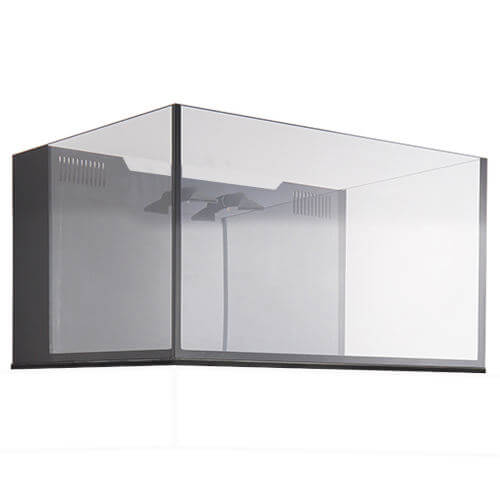
15 Gallon
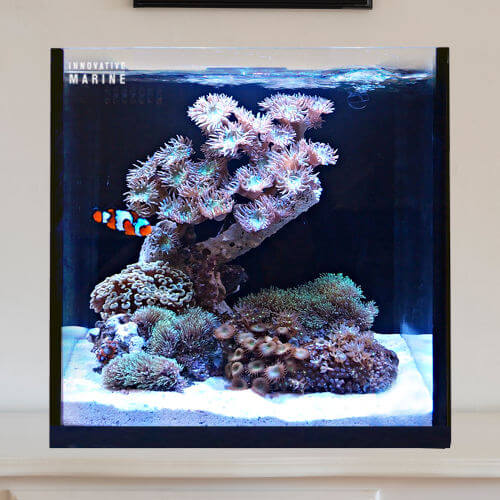
AIO Tank
The tank arrived well-packed and without any damage. It looked sharp even sitting empty on the refurbished dresser I’m using as a stand.
Why This Footprint Wins for Clownfish
- Massive Surface Area: This maximizes gas exchange, keeping oxygen levels consistently high.
- Depth Perception: The 20-inch front-to-back depth gives you incredible aquascaping flexibility. You can build a central rock structure with plenty of open space around it.
- All-In-One (AIO) Simplicity: The filtration is completely hidden in a rear chambers partition. No external sumps, complex plumbing, or flooding risks to worry about!
The Gear List: What’s Running My System
My goal with this tank was simplicity. I did not want to run a tank with a sump or a lot of expensive equipment such as dosing pumps and system controllers. While equipment like this can be invaluable for high-end systems, the cost can be a non-starter for many hobbyists.
To keep a nano reef pristine with the above in mind, you have to choose lightweight, reliable equipment that fits cleanly into an AIO rear partition. Here is the exact gear loadout I run on my 25-gallon lagoon:
Filtration & Media
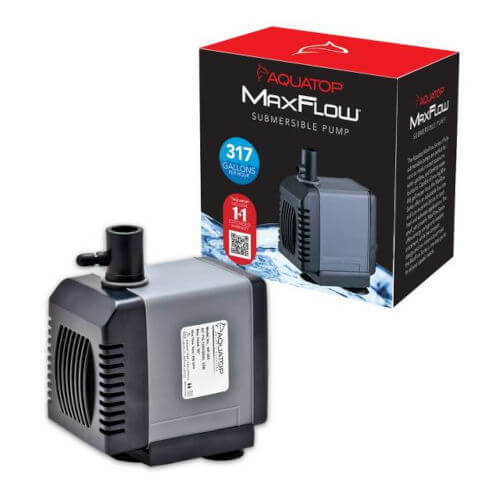
- The Pump: Upgrade the stock return pump to a controllable DC pump (like the Innovative Marine MightyJet). This allows you to fine-tune the flow rate perfectly without over-powering your fish. The IM Fusion Lagoon comes with two pumps. I kept one and replaced the other with an Aquatop MaxFlow submersible pushing 317 gallons per hour.
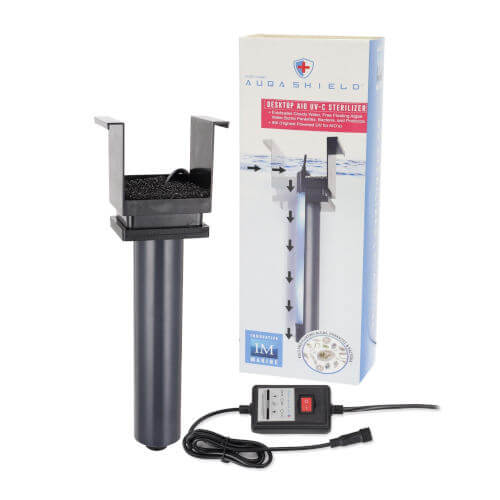
- Mechanical: Eventually, I’d like to use a custom filtration media basket loaded with high-quality filter floss that I can swap out weekly in seconds. However, at the moment I have a filter sock in one overflow and a UV light in the other. The filter socks are reliable and simple. I have six socks that I swap out every other day or so and toss them all in the washing machine when I get down to my last one. I have a UV light because I was having a very tough time with dinoflagellates during the cycle and it was causing major issues (a story for another day).
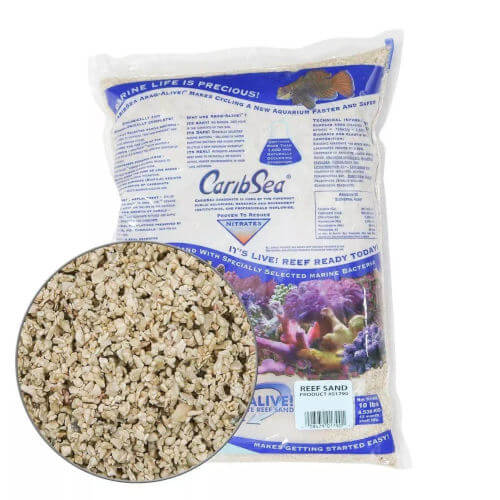
- Chemical/Biological: In other chambers of the AIO section, I have a few small bags of carbon to keep the water crystal clear and a media bag with Fluval Biomax ceramic rings for extra biological filtration. I had considered going with a bare-bottom tank but opted instead for 20 pounds of CaribSea Arag-Alive reef sand to help even more with bio-filtration.
Lighting the Reef
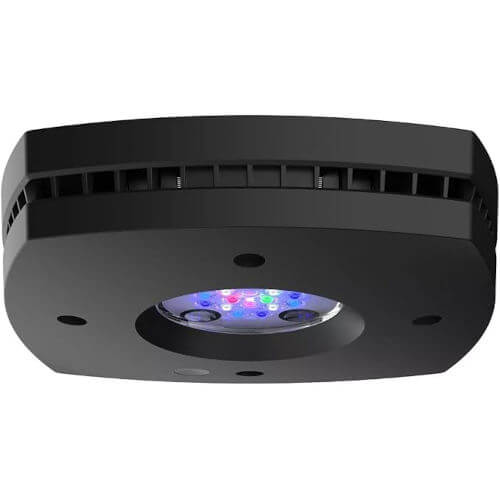
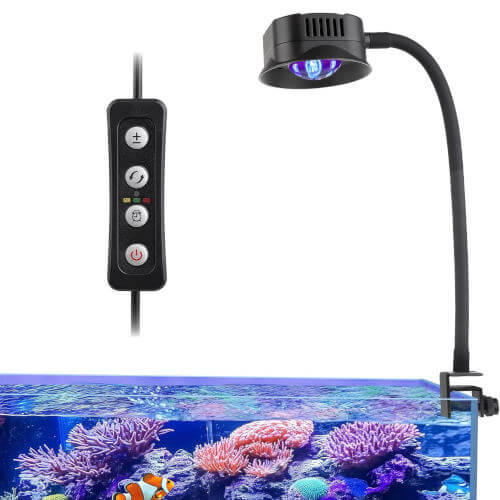
- The Top Choice: A single puck LED fixture with a flexible arm mount (like the AI Prime 16HD or Radion XR15). A more economical choice with a similar layout would be the hygger 36W reef light.
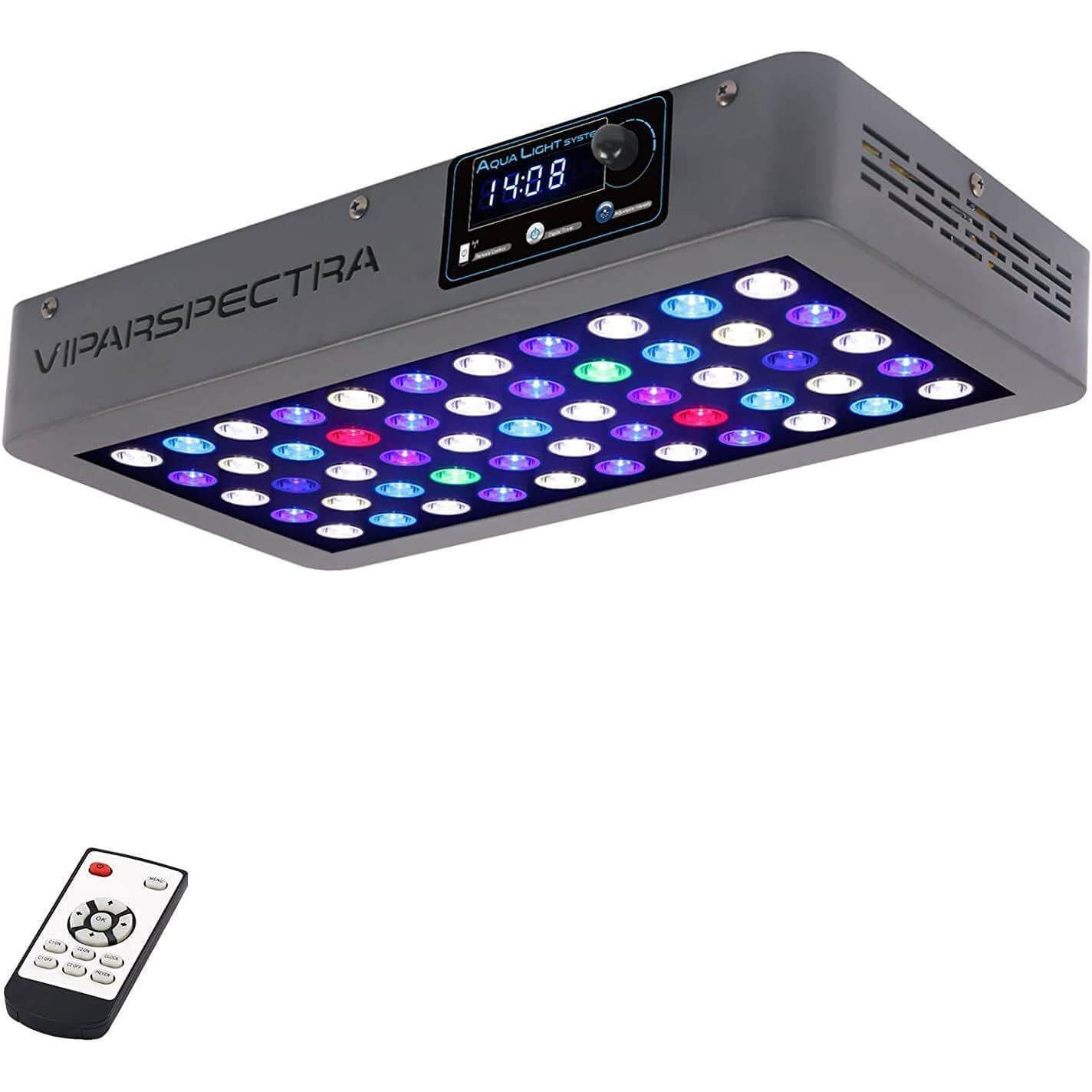
- My Light: I happened to have an extra LED light from a tank that is no longer running. It’s an inexpensive full spectrum LED. It’s probably too much light for the tank, but it’s what I had available, is fully adjustable, and does a great job.
- The Settings: Clownfish themselves aren’t picky about lighting, but if you want to keep host anemones (like Bubble Tips) or corals vibrant, you need a light capable of generating strong, programmable blue spectrums. I run the blue spectrum all day (from 9:30 am to 9:30 pm) and only run the white spectrum for a couple of hours in the middle of each day. I do this because these are the main times I like to view the tank, and I prefer the blue spectrum to see the glow of the corals.
Flow & Temperature Control
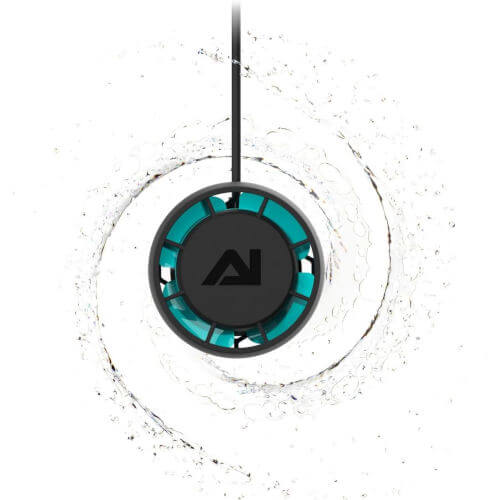
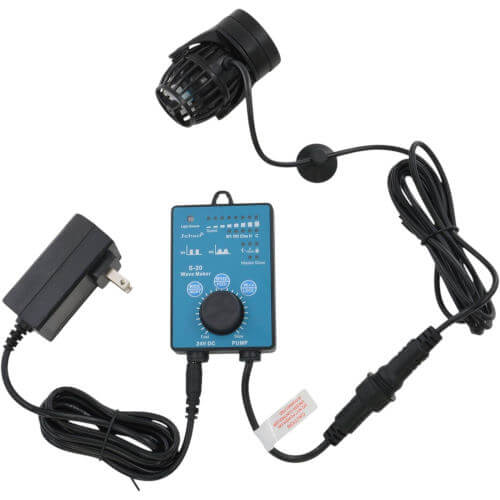
- Wavemaker: A small, low-profile smart powerhead (like the Nero 3 or Vortech MP10). Place it on a low, pulsing setting to simulate a gentle reef slope – clownfish love a steady flow but don’t want to fight a washing machine.
- My Choice: I went with a Jebao SW-4 wave maker with controller. This was my choice because I’ve used Jebao previously with great results. It’s also much less expensive, which was one of the goals of this build.
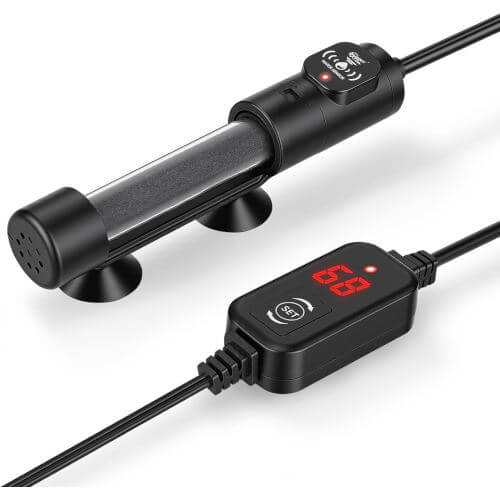
- Heater: At least a reliable 75W heater – titanium preferred – connected to an external temperature controller. Pro-tip: Never trust a built-in heater thermostat in a nano tank; an external controller prevents your heater from sticking “on” and cooking your tank.
- My Choice: I opted for a 150W hygger – mainly because I like the stability of a higher wattage and the hygger has good ratings. Most importantly, it fits well in the chambers of the AIO section of the tank. While I’d prefer a titanium heater, the cost and fit weighed heavily on my decision.
Aquascaping & Room to Swim
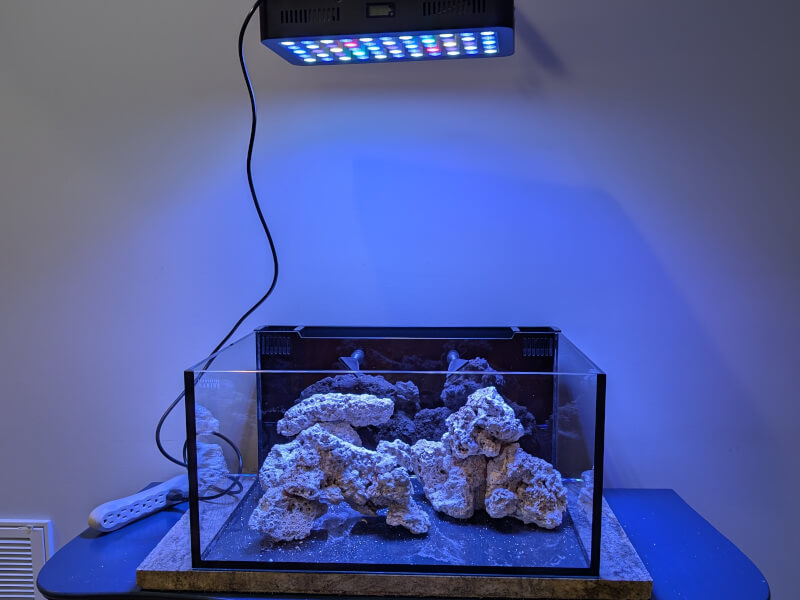
When arranging your rockwork in a lagoon tank, keep it open. Clownfish have a signature “waddly,” bobbing swimming style and like to establish a clear home base.
- Create Caves and Overhangs: Build structures using dry branching or shelf rock. This gives them shaded zones to sleep in and a natural territory to claim. I went with three separate structures, leaving space in between each one.
- Leave a Sand Border: Keep the rock a few inches away from the glass. This allows for easy cleaning and gives your clowns a clear flight path around the entire structure.
- Spawning Prep (Optional): If you are keeping a bonded pair with the hopes of breeding your clownfish down the line, place a flat ceramic tile or a small 4-inch terracotta pot near the base of the rockwork. They will clean it aggressively and use it as a permanent nesting canopy. You can always do this later, once the pair establishes their preferred “host” in the tank.
Stocking the Lagoon: My Personal Inhabitants
What are the current inhabitants of my 25-gallon desktop lagoon? It is a highly curated, peaceful community built around my absolute favorites:
- The Showpieces: A trio of Black Storm Clownfish. Their intense, high-contrast white and velvety jet-black markings pop beautifully under the reef LEDs.
- The Clean-Up Crew & Inverts: A handful of Cerith snails, Astraea snails, Trochus snails, and a couple of Blue-Legged Hermit crabs to sift the sand bed and manage algae. I also have a Tiger Pistol Shrimp that builds lots of tunnels and caves around the rockwork.
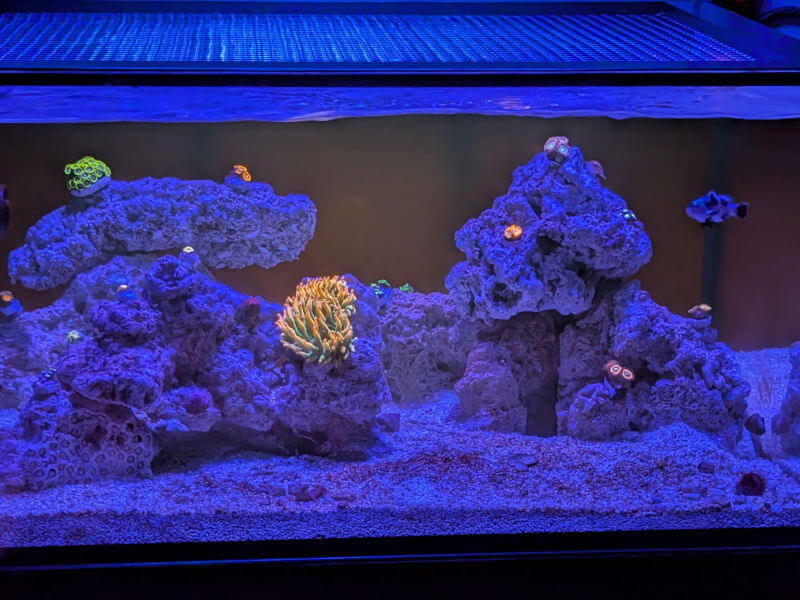
- The Coral: A vibrant collection of colorful zoanthids growing along the rocks, paired with a couple of Bubble Tip Anemones (Entacmaea quadricolor). I have patches of Green Star Polyps (GSP) on the back wall. I also have a few other soft corals, such as clove polyps and mushrooms. I will be sticking with soft corals with this tank for simplicity – mostly zoanthids.
A Note on Anemone Hosting: While Ocellaris strains do not require an anemone to live a long, healthy life in captivity, watching them settle into a host is the ultimate reward. Just ensure your tank has been up, cycled, and mature for at least 6 months before adding a delicate anemone! (If you’re struggling to get your pair to move in, be sure to check out our complete guide on Getting a Clownfish to Live in a Host Anemone).
Filling the Tank and Cycling
I placed my rockwork first, then added my sand, and followed it up with well-mixed saltwater (I personally use Reef Crystals). Because I can be a bit impatient, I decided to use DrTim’s One & Only nitrifying bacteria. This bottled bacteria allows you to safely add fish to the tank right away, provided you follow the label instructions carefully.
The first inhabitants of my tank were a few colorful zoanthids and a beautiful pair of Black Storm clownfish. Unfortunately, I did lose one of the clowns a couple of months later. It’s a sad reality of the hobby that happens to all of us, but the remaining larger clownfish is still doing incredibly well today, ruling the tank alongside all of the original zoas!
Later on, I actually introduced a third juvenile to create the trio I have running now – if you’re curious about how that works, check out my FAQ section below on keeping three clownfish together!
The Nano Tank Maintenance Strategy
Nano tanks are incredibly rewarding, but their low water volume means minor mistakes can lead to rapid parameter swings. Here is the simple weekly routine I use to keep my 25-gallon lagoon running like clockwork:
- The 10% Weekly Water Change: Every weekend, I siphon out 2.5 to 3 gallons of water. This replaces essential trace elements and keeps nitrates strictly below that 20 ppm threshold.
- Daily Top-Offs: Saltwater evaporates, but salt does not. If your water level drops, your salinity spikes. I highly recommend installing a small Automatic Top-Off (ATO) system in the rear chamber to automatically replenish evaporated water with fresh RO/DI water daily. I bought an inexpensive ATO from Amazon and it’s been a game changer.
- Varied Diet: I feed my clowns small amounts twice a day. Their main diet consists of frozen Rod’s Food Original Blend. I also feed high quality pellets – Hikari Marine-S pellets and New Life Spectrum Marine Fish Formula. I spot feed the pistol shrimp and starfish every couple of days to make sure they stay healthy as well as my zoanthids with Reef Roids about once per week.
Frequently Asked Questions
Can I keep three clownfish together in a 25-gallon tank?
Generally, it is best to stick to a single, bonded pair (two fish). As clownfish mature, they establish a strict female/male hierarchy. While I am successfully running a trio of Black Storms in my lagoon, this requires specialized monitoring, adding them simultaneously as juveniles, and a layout with plenty of visual breaks to avoid territorial fighting. For beginners, a pair is always the safest and happiest route! There is definitely the risk that I’ll have to remove one of the fish at some point.
Are lagoon tanks harder to maintain than regular tanks?
Not at all! In fact, because they are shallow, reaching down to clean the glass, siphoning the sand, or rearranging corals is significantly easier than working in a deep, tall tank.
What is the best size for a clownfish aquarium?
There really is no one best size. Anything larger than about a 10-gallon tank will work well. It really depends on which clownfish tank mates you’d like to keep with your new fish!
What do you think?
Are you getting ready to set up your very first nano reef, or are you looking to upgrade to a lagoon style?
Drop by our official Facebook page and share photos of your current setup or your favorite designer pairs – we’d love to see what you’re building! And if you’re still hunting for the perfect fish to stock your new glass box, don’t miss our comprehensive Ultimate Clownfish Buying Guide to help you pick a healthy winner at the store.
Chad’s Pro-Tip: Want to see how the Black Storms compare to other wild patterns before you buy? Take a stroll through our Designer Clownfish hub to find your perfect match!