
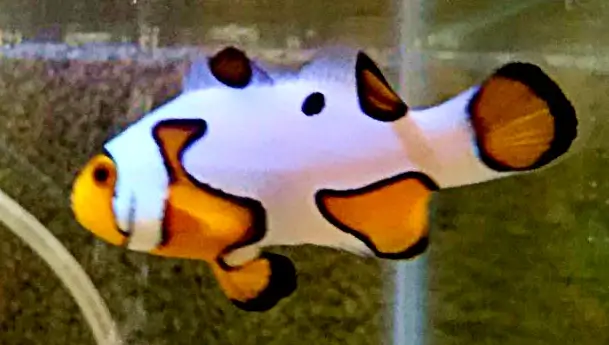
If you’ve ever wanted a piece of abstract art swimming through your reef tank, the DaVinci Clownfish is exactly what you are looking for. Unlike standard clownfish with their neat, uniform bands, the DaVinci breaks all the traditional rules of geometry. With wild, swirling white patterns that fuse the standard stripes together into a seamless canvas, this morph stands out as a true showpiece in any saltwater display.
Let’s dive into everything you need to know about this incredible designer variant, from its exact genetic roots to the fish-room secrets for keeping them thriving.
Species Definition: Ocellaris vs. Percula
The DaVinci clownfish is a captive-bred designer color morph of the standard Ocellaris Clownfish (Amphiprion ocellaris). It is not a True Percula. This is important information for hobbyists because Ocellaris variants are very hardy, quite peaceful, and do very well in fish-only tanks as well as full reef setups.
It’s also crucial to make a distinction between the DaVinci variant and the Picasso morph. They look quite similar at first glance – with their abstract patterns of orange, white, and black – but the DaVinci is an Ocellaris, while the Picasso Clownfish is a Percula (Amphiprion percula).
The Eye Test
Because the DaVinci is a true Amphiprion ocellaris variant, a quick look at the eyes will confirm its species. Look closely at the iris: Ocellaris clownfish feature dark, black-dominated eyes with a clear ring, lacking the bright orange or fiery irises typical of a True Percula. This is one of the defining differences between Ocellaris and Percula clownfish. Additionally, DaVinci clownfish possess 11 dorsal spines (occasionally 10), which are taller and more pronounced than those of a Percula.
Quick-Glance Care Sheet
| Feature | Details |
|---|---|
| Scientific Name | Amphiprion ocellaris var. “DaVinci” |
| Care Level | Easy / Beginner-Friendly |
| Temperament | Semi-aggressive (Peaceful alone, can be territorial in established pairs) |
| Max Size | 3.5 – 4 inches |
| Reef Compatible | Yes (Excellent reef citizen) |
The DaVinci Pattern Breakdown
The defining trait of a DaVinci clownfish is the fusion and randomness of its white bars. On a wild-type Ocellaris, you see three distinct vertical white bands. On a DaVinci, the first and second bars (and frequently the third) break out of their vertical constraints and flow horizontally into one another.
This creates an abstract, wavy outline where the brilliant white paint-stroke contrast meets a rich, deep orange or red-orange background. The edges of these swirling white markings are heavily outlined in a crisp, sharp black border, making the pattern pop intensely under blue reef LED lighting. The first white bar often extends over the head of the fish as well, like a helmet, leading to its other common names – the Gladiator Clownfish and Stormtroopers.
The Collector’s Grading Scale
Breeders and wholesalers evaluate and price individual DaVinci specimens based on the degree and symmetry of their bar fusion:
- Standard Grade (DaVinci Grade B): The first and second white bars connect on at least one side of the fish’s body. The connection might be a narrow white bridge, leaving a distinct gap elsewhere.
- Premium / Grade A (DaVinci Grade A): The first and second stripes are completely and seamlessly connected on both sides of the fish, forming a thick, continuous horizontal white ribbon from head to tail. The lines are smooth, bold, and highly symmetrical.
- Extreme Morphs: This includes variations like the Black DaVinci (where the traditional orange background is completely replaced by a deep, velvety jet-black as the fish matures) or ultra-white variants where the white coverage bleeds down across the midsection and onto the head, leaving only minor accents of color on the face and fins. All three lines of a standard clownfish should be touching seamlessly for a DaVinci to be considered Extreme. Black DaVinci may be considered Extreme if they have no orange coloration and a well-developed pattern.
Where did DaVinci Clownfish Come From?
The DaVinci lineage is a fascinating chapter in designer clownfish history. The mutation originally surfaced and was stabilized by premier commercial hatcheries, most notably C-Quest, Sea & Reef Aquaculture, and ORA (Oceans, Reefs & Aquariums). It was isolated from select pairings of Davinci / Gladiator bloodlines. Rather than being a completely random wild anomaly, it is the result of years of meticulous, generational selective breeding aimed at emphasizing bar-fusion traits.
The Rarity Factor
While the gene for bar fusion is stable, nature loves variety. A single clutch of eggs from a pair of DaVinci clownfish will not yield 100% Premium Grade A offspring. A significant percentage of the fry will turn out as standard grades or even misbars. Because producing a perfectly symmetrical, high-coverage Grade A DaVinci requires low yields per clutch, the retail value for top-tier specimens remains premium.
In {year} you can expect to pay roughly $40 for Grade B DaVinci clownfish. Premium DaVinci clownfish may still fetch prices around $100, depending on pattern and lineage. Find quality clownfish breeders on our clownfish buying guide.
The “Healthy Mutation” Reassurance
If you are worried that these unique patterns mean a weak fish, rest easy. The DaVinci is a completely natural, healthy genetic mutation that has simply been highlighted and stabilized through selective breeding. These are not dyed, injected, or genetically modified in a laboratory (“franken-fish”). They possess the exact same robust immune systems, active behavior, and impressive 15 to 20-year lifespans as standard wild-type Ocellaris clownfish. In fact, DaVinci Clownfish are guaranteed to be tank-raised, assuring that they are more acclimated to life in an aquarium and we are not removing any fish from the wild reefs!
Husbandry & Environment Requirements
DaVinci clownfish are quite easy to care for and have exactly the same requirements as the standard Ocellaris Clownfish.
Tank Layout
- Minimum Tank Size: 10 gallons for a single fish or a bonded pair. While they can live in smaller nano tanks, choosing a 20-gallon long or larger gives them ample room to establish a territory without harassing tankmates.
- Aquascaping: Provide plenty of live rock configured with caves, overhangs, and swim-throughs. If your primary goal is to breed your clownfish, many keepers opt for a bare-bottom tank setup featuring a simple ceramic tile or a clay flower pot, which makes egg deposition and cleanup incredibly straightforward.
Water Parameters
DaVinci clownfish thrive in standard, stable marine reef environments:
| Salinity / Specific Gravity | 1.024 – 1.026 |
| Temperature Range | 75°F – 78°F (24°C – 26°C) |
| pH | 8.1 – 8.4 |
| The “0-20 Rule” | Ensure your tank is fully cycled before introducing them. Ammonia and Nitrite must be a strict 0 ppm, and Nitrates should ideally be kept under 20 ppm. |
DaVinci Clownfish Diet & Nutrition
To keep those fiery orange backgrounds and stark white patterns from fading, feed a varied, high-quality omnivore diet. Rotate between:
- High-protein marine pellets and flakes enriched with carotenoids (to boost orange coloration).
- Frozen Mysis shrimp, enriched brine shrimp, and other frozen reef foods.
- Finely chopped seafood mixes.
Clownfish should be fed at least once daily. Feeding small amounts 2–3 times a day keeps their energy up and keeps aggression to a minimum.
DaVinci Clownfish Anemone Hosting
Anemones are completely optional. DaVinci clownfish do not need a host to survive and live happy lives in captivity. However, if you want to get your clownfish to live in a host anemone and witness that classic symbiotic relationship, their preferred natural hosts include the Bubble Tip Anemone (Entacmaea quadricolor) and the Magnificent/Carpet Anemone (Heteractis magnifica). Be warned: in a reef tank, they may just as easily choose to host in a patch of torch corals, hammer corals, or even a powerhead!
Pairing DaVinci Clownfish
If you’d like to pair up your DaVinci, it’s helpful to know whether you have a female or male clownfish first. Like all Ocellaris, DaVinci clownfish are born as sexually undifferentiated juveniles and are sequential hermaphrodites. When pairing them, the best strategy is to introduce one larger fish and one significantly smaller fish. The larger, dominant fish will transition into the female, while the smaller, submissive fish will remain the male. They will establish dominance through a series of shakes, twitches, and minor chases.
DaVinci Breeding Options
If you cross a DaVinci clownfish with other variants, you can unlock some spectacular genetic combinations:
- DaVinci x DaVinci Clownfish: Will result in a mix of standard Ocellaris, misbar clownfish, various levels of DaVinci patterns (B Grade to Extreme), as well as Wyoming White clownfish.
- DaVinci x Standard Wild-Type Ocellaris: Will yield a mix of standard Ocellaris, misbar Ocellaris, and lower-grade DaVinci (Gladiator) phenotypes.
- DaVinci x Snowflake: Can result in Frostbite variants, blending the wide-set white patches of the Snowflake Clownfish line with the sleek, connected lines of the DaVinci. This crossing often creates beautiful patches of “blue” around the edges between white and black markings.
- DaVinci x Black Ocellaris: Over successive generations, this cross stabilizes the Black DaVinci, replacing all orange coloration with deep, dramatic midnight black.
Frequently Asked Questions
Are DaVinci clownfish harder to care for than regular clownfish?
Not at all! Because they are 100% captive-bred Ocellaris clownfish, they are incredibly resilient, well-adjusted to aquarium life, and readily accept commercial foods. They are just as hardy – if not hardier – than standard wild-type clownfish. Follow the standard clownfish care guide that we’ve outlined and you’ll have a happy, healthy clownfish for years to come.
Why is my DaVinci clownfish changing colors or darkening as it grows?
This is a completely natural phenomenon known as maturation pigment shift. As Ocellaris clownfish age, mature, and adjust to high-intensity reef lighting, they naturally develop more black pigmentation. You will often notice the black borders around the white swirls getting significantly thicker and bolder over their first two years.
Can I pair a DaVinci clownfish with a standard version of the same species?
Yes, absolutely. Because they are the exact same species (Amphiprion ocellaris), a DaVinci will readily pair up with a standard orange Ocellaris, a Black & White Ocellaris, a Snowflake, or even a Picasso (A. percula). Just ensure you follow the standard rule of pairing a larger fish with a smaller fish to avoid severe territorial fighting.