
Whether you are looking for a classic “Nemo” or a high-end designer variant, buying a clownfish is an investment in a companion that can live for 15 years or more. However, not all clownfish are created equal.
This guide is based on my years of reef-keeping experience and research. I’ll show you exactly what to look for in a healthy fish, what to avoid, and my personal recommendations on where to buy them.
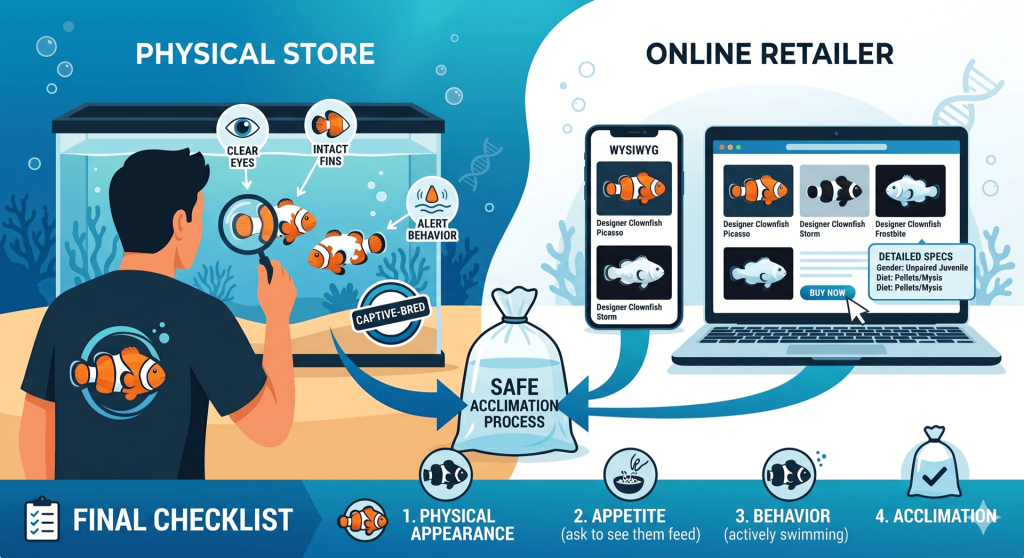
1. What to Look for in a Healthy Clownfish
When you are standing in front of a tank at a local fish store (LFS) or looking at a “What You See Is What You Get” (WYSIWYG) listing online, use this checklist to ensure you are getting a healthy specimen.
Physical Indicators
- The Fins: Fins should be clear and intact. Avoid fish with “clamped” fins (held tight to the body) or visible rot/fraying.
- The Skin: Look for smooth, vibrant scales. Avoid fish with white spots (Ich), a “velvety” or peeling appearance (Brooklynella—a common clownfish killer), or any red sores.
- The Eyes: Eyes should be clear and bright. “Cloudy” eyes are a sign of bacterial infection or poor water quality.
- The Belly: A healthy clownfish should look “filled out.” Avoid fish with “sunken” bellies, which can indicate internal parasites.
- The Shape: Watch out for misshapen fish. Look for a smooth outline in a natural clownfish shape. Don’t be blinded by a fish’s patterns – look out for pinched heads and flared gills.
Behavioral Indicators
- The Swim: Clownfish have a naturally “waddly” or bobbing swimming style. However, they should be active and alert. Avoid fish that are hovering listlessly near the surface or the heater.
- The Appetite: If you are at a physical store, ask the staff to feed the fish. A healthy clownfish is an enthusiastic eater. If it ignores food, do not buy it.
You will have a much easier time caring for your clownfish when you start with a high-quality, healthy fish in the first place!
2. Captive-Bred vs. Wild-Caught
I almost always recommend captive-bred clownfish for several reasons:
- Hardiness: They are already adjusted to aquarium life and artificial foods.
- Disease: They have a much lower risk of carrying wild parasites like Brooklynella.
- Sustainability: It protects our natural reefs.
- Selection: Almost all “designer” variants (like Snowflakes or Picassos) are exclusively captive-bred.
3. Where to Purchase Your Clownfish
You generally have two options: your local fish store or an online retailer.
- Local Fish Store (LFS): The benefit is seeing the fish in person and taking it home immediately. The downside is a more limited selection of designer patterns.
- Online Retailers: This offers the best selection of rare genetics and often direct-from-breeder health guarantees.
Many local fish stores will order fish for you as well. Ask them if they can get fish from ORA, Sea & Reef, or Proaquatix for great selections of designer clownfish. Some wholesale breeders, such as Proaquatix, even have WYSIWYG clownfish, which your LFS can order directly for you.
Recommended Online Vendors
Based on my research and experience, these are the top places to source healthy, high-quality clownfish.
| Vendor Name | Specialty | Shipping Policy | Why I Recommend Them |
| Saltwaterfish.com | Wide selection | Free over $199 ($14.95 box fee) | Well established in the industry. Offers WYSIWYG – but you must be quick! |
| Top Shelf Aquatics | Designers | Free over $299 | Solid shipping experience – offer WYSIWYG clownfish including pairs. |
| World Wide Corals | High-end Designers | Free over $299 | Well-known in the industry – great selection of WYSIWYG clownfish. |
(Note: I recommend these sites based on my own experience. Your experience may vary.)
Are you a clownfish breeder or dealer and want to be listed, or know someone who is? Reach out to get on our list.
4. Pro Tips for the Ride Home
- Temperature Control: If buying locally, bring an insulated cooler to keep the water temperature stable during the drive.
- Acclimation: There are two schools of thought here. Drip acclimation is a good choice for locally purchased fish that haven’t been in a bag for very long. However, when fish ar shipped, the ammonia within the bag can build up and poison the fish while drip acclimating. I’ve had good luck with temperature acclimating, and then directly putting the fish in the tank. Just be sure to check that the salinity is very close first, and don’t dump the bag water in the tank.
- Quarantine: Even if a fish looks healthy, a 2-4 week stay in a simple quarantine tank is the best way to protect the rest of your reef.
Need more help choosing? If you’re stuck between a Snowflake, Black Storm, or a Picasso, check out our Designer Clownfish Types gallery to see which look fits your tank best!